
Lyon County Municipal Court Warrants
“Municipal warrant” is a useful search phrase, but it does not name a separate court in Lyon County. Iowa unified its trial courts in 1973 and abolished municipal, mayor's, police, and justice-of-the-peace courts. A city traffic citation, simple misdemeanor, or municipal infraction is handled within the Iowa District Court structure. A judicial magistrate may hear those lower-level matters and can issue a warrant when the law permits. District associate judges and district judges handle matters within their broader authority.
The Lyon County Clerk of the District Court maintains the case record. The Lyon County Sheriff's Office handles countywide law enforcement and warrant service, while a city may be named on the citation or appear as the place of an incident. That division matters. City Hall may answer a parking or local administrative question, but it cannot be assumed to recall a District Court warrant. The issuing court must authorize a recall or other change.
Lyon County's Unified Court Since 1973
The unified system prevents a common search mistake. A person may remember receiving a ticket in Rock Rapids, George, Inwood, Larchwood, or Doon and then look for a city court website. No such criminal municipal court exists here. The record instead follows the citation into Iowa District Court in Judicial District 3. The appropriate magistrate or judge makes the court decision, and the Lyon clerk records it.
A practical flow is: city-location citation → District Court filing → missed required appearance → court-issued arrest warrant for failure to appear → clerk transmission to law enforcement → service or court-authorized recall. Iowa's official language under Iowa Code section 805.5 is “arrest warrant” for failure to appear. “Bench warrant” is often used in conversation, but it is not a city-court writ kept by a separate municipal clerk.
Note: A city name on a ticket identifies the place or local matter, not a separate Lyon County municipal court.
Lyon County Cities With Municipal Courts
None of Lyon County's cities operates a separate municipal court. The distinction is between a city office, the unified District Court, and the county sheriff. The five largest incorporated cities all use the same court and enforcement framework for criminal traffic and municipal-infraction cases. Parking matters can remain with the relevant city clerk because Iowa Courts Online says city parking violations do not appear in its payment search.
| City | Court route | Local role |
|---|---|---|
| Rock Rapids | Iowa District Court | City police may issue citations; city parking stays with City Hall. |
| George | Iowa District Court | County sheriff provides contracted law enforcement. |
| Inwood | Iowa District Court | County sheriff or another proper agency enforces city provisions. |
| Larchwood | Iowa District Court | Sheriff provides countywide warrant enforcement. |
| Doon | Iowa District Court | City office handles local administration, not criminal warrants. |
Lyon County City Citations
Before searching, identify the kind of paper involved. A city parking notice usually belongs with the city clerk. A traffic citation, scheduled violation, simple misdemeanor, or municipal infraction normally enters Iowa District Court. If the ticket required an appearance and the person willfully failed to appear, the court must issue an arrest warrant under section 805.5. Paying a debt later may not, by itself, satisfy an appearance order.
- Municipal infraction
- A city-code matter heard within Iowa District Court, not in a separate city court.
- Failure to appear
- Missing a required court appearance; Iowa law uses an arrest warrant as the response.
- Recall
- A court action that withdraws a warrant. Payment alone is not proof that recall occurred.
- City parking
- A local city-clerk matter excluded from the Iowa Courts Online payment search.
Checking a Lyon County Municipal Warrant
Use more than one official channel. Iowa Courts Online provides free public case information, while its payment search accepts a name or a full or partial case or citation number. Select Lyon County. The sheriff publishes a PDF snapshot rather than an interactive name form. Restricted or recently issued material may not be visible, so an empty result is not final confirmation.
- Search Iowa Courts Online by first and last name, or use the full case or citation number. Choose Lyon County and compare the docket carefully.
- Review the official sheriff Warrant List. Check its timestamp and use any matching warrant number only as a lead.
- Call the Lyon County Clerk at 712-472-8530 for the court docket, next setting, payment status, and any failure-to-appear entry.
- Call sheriff/dispatch at 712-472-8300, or the public warrant-role contact at 712-472-8311, for current enforcement routing. Jail and bond questions go to the 24-hour jail line at 712-472-8356.
- For a releasable record not found online, make a focused verbal or written request to the clerk or sheriff custodian. State the name, case or citation number, and record sought.
Lyon County Sheriff PDF Limits
The sheriff's Warrant List can show a Lyon County municipal-warrant concern after it reaches enforcement, but it is a static document. The inspected version had a printed timestamp, and no official refresh schedule or completeness promise was found. It may omit restricted unserved warrant material. A record may also sit at the court level before the public PDF changes. Absence from the PDF therefore does not prove that no warrant exists.
Key point: Confirm a possible city-related warrant with both the Lyon County Clerk and sheriff before relying on a PDF snapshot.
The separate arrest log records custody events, while the inmate roster records current custody. Neither is a substitute for the warrant list or court docket. The IOWA System connects law-enforcement agencies, but it has no public resident search. These boundaries make the clerk-and-sheriff confirmation chain essential.
Inside a Lyon County Municipal Warrant
The public sheriff snapshot and court docket serve different needs. Read the warrant number and issue date first, then compare the type or statute section with the charge. Bond is a case-specific field, not a county schedule. The court docket is the better source for the next hearing and a judge's later order, while the sheriff confirms the current enforcement snapshot.
| Warrant number | The identifier used to distinguish the warrant and support an office call. |
|---|---|
| Issue date | The date the warrant was issued, useful when several entries relate to one case. |
| Type and charge | Read together to distinguish failure to appear, contempt, probation, or a traffic-related entry. |
| Issuing court | Iowa District Court in Lyon County, acting through the judge or magistrate with jurisdiction. |
| Bond and disposition | Case-level terms that require current confirmation from the sheriff, jail, or clerk. |
The Lyon Clerk Keeps Court Records
The Lyon County Clerk of the District Court is at 206 South Second Avenue, Rock Rapids, Iowa 51246. The court page lists 712-472-8530, fax 712-472-8537, and CountyClerk.Lyon@iowacourts.gov. Courthouse hours are posted as Monday through Friday, 8:00 a.m. to 4:30 p.m., except holidays, though department hours can vary. This is the proper office for the filed case, missed setting, fine, payment record, and judicial disposition.
The Iowa Judicial Branch courthouse history identifies the local building where the unified court and clerk route is centered.
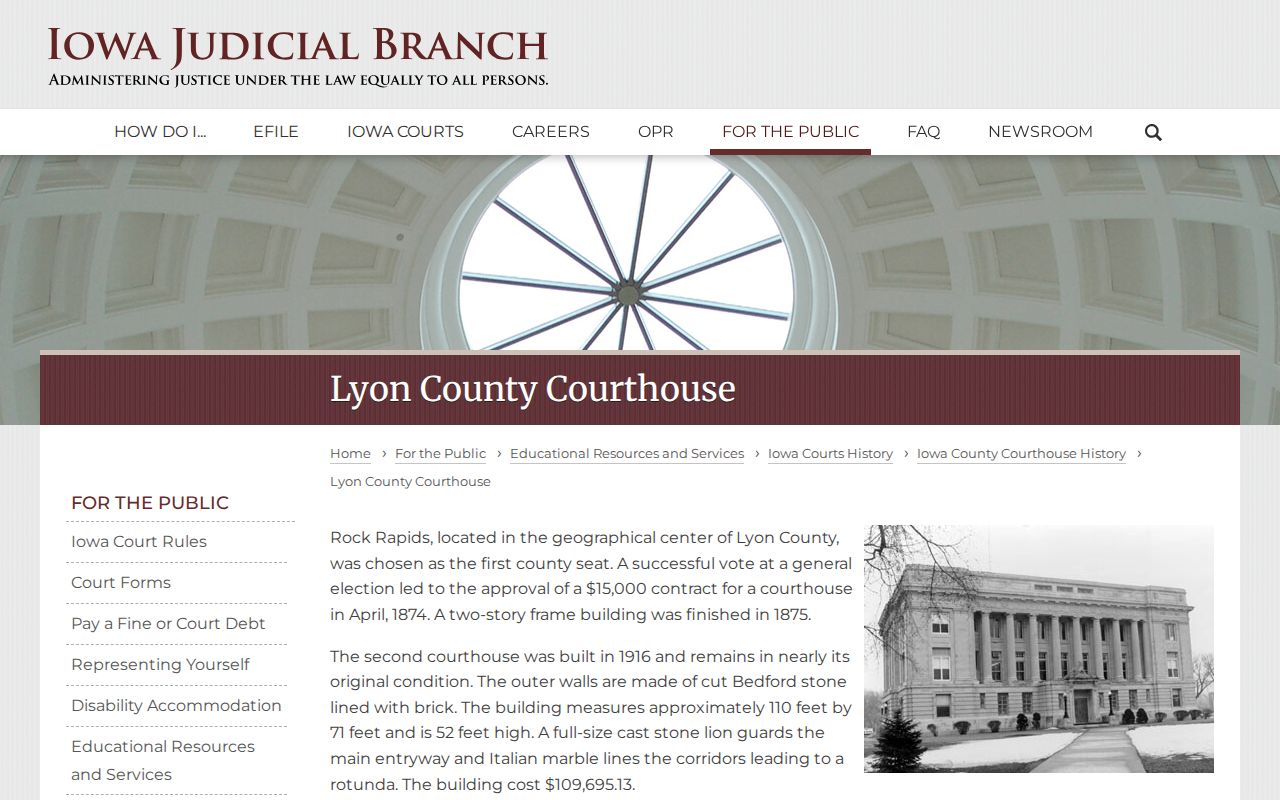
The courthouse view reinforces that city-related cases route to Lyon County's Iowa District Court office rather than a separate municipal court.
Lyon County Clerk of District Court
206 South Second Avenue
Rock Rapids, IA 51246
712-472-8530
Ask for the case or citation number, current docket entry, next required act, and whether a judge has recalled the warrant.
A courthouse public terminal may offer access to public case documents. A request can be verbal or written and must give enough detail to identify the record. Copying, postage, staff review, redaction, or electronic work may carry fees, but no fixed Lyon County warrant-record fee was located. Unserved arrest-warrant papers, juvenile records, sealed files, and other confidential material may remain unavailable.
Note: Court staff can describe the record and procedure, but only a judicial order can change an active warrant.
Lyon County Parking Versus Court Cases
A city parking ticket and a criminal traffic citation follow different routes. Iowa Courts Online expressly excludes city parking violations from its payment search. A Rock Rapids, George, Inwood, Larchwood, or Doon city clerk may therefore be the right contact for parking debt. That does not make the clerk a municipal court clerk, and it does not give City Hall authority over an Iowa District Court arrest warrant.
| Matter | First contact | What to confirm |
|---|---|---|
| City parking | Relevant city office | Local notice, balance, and city payment instructions |
| Traffic citation | Lyon County Clerk | Case number, appearance, payment, and docket status |
| Failure to appear | Clerk plus sheriff | Warrant status, required court act, and enforcement |
| Custody or bond | Lyon County jail | Current custody and accepted bond route |
Ask one direct question when the paper is unclear: “Is this a city parking matter or an Iowa District Court case?” That answer prevents payment to the wrong office and keeps the city administrative record separate from the criminal or infraction docket.
How to Resolve a Municipal Warrant
Start with confirmation, not payment. The Lyon clerk must identify the case, the missed act, and what the court now requires. Depending on the record, the next step may be a new appearance, a court-debt plan, bond, an attorney's request or motion, or another judicial order. No universal Lyon County recall procedure or city warrant-clearing form is posted. There is also no current official local amnesty or safe-surrender program.
- Give the Lyon clerk the name and case or citation number. Ask whether the docket shows a failure-to-appear arrest warrant and what event or filing is required.
- Discuss a controlled response with an Iowa attorney when arrest is possible. Call the sheriff or jail for enforcement, custody, and exact bond instructions.
- Use the county payment-plan route only if the clerk or county attorney confirms eligibility and explains whether court action is still required.
- Keep the order and payment receipt. Confirm the updated status with both the clerk and sheriff because their public systems may update at different times.
Warning: Paying court debt does not automatically prove a Lyon County warrant was recalled or the underlying case ended.
The county payment-plan materials offer wage assignment, self-made monthly payments, or automatic card authorization for eligible debt. The form uses case numbers and generally states a $50 monthly minimum unless another arrangement exists. A missed payment can prompt contempt action. These terms address debt, not every warrant consequence. Bond also secures release but does not dismiss the case.
Lyon County Municipal Warrant Access
Iowa Code Chapter 22 governs examination of public government records, subject to specific confidentiality rules. Iowa Judicial Branch guidance says a criminal case with an outstanding arrest warrant can remain confidential until service. Search-warrant materials, juvenile files, sealed matters, and active-investigation records can also be restricted. A public list is therefore useful but cannot be treated as a full export of every warrant known to law enforcement.
For a focused request, contact the lawful custodian. District Court filings go to the Lyon clerk or a courthouse public terminal. A sheriff record request can begin at 410 S. Boone Street, Rock Rapids, or 712-472-8300; the county directory lists the evidence custodian at 712-472-8312. Describe the exact record and accept that releasable portions may require review or redaction.
Direct confirmation also protects against stale information. The court may have entered an order that has not reached the PDF, or law enforcement may hold material that cannot yet be released. Use the record to understand and resolve your own or a family member's matter, then rely on the issuing court and sheriff for the current answer.