
Lyon County Arrest Warrants Explained
Every Lyon County arrest warrant begins with probable cause, a set of facts strong enough for a judicial officer to tie a specific offense to a named person. The paperwork starts small. Under Iowa Code section 804.1, someone files a complaint charging a public offense before a magistrate. A supporting affidavit may add sworn facts. The magistrate weighs what is sworn, not just a police label. If probable cause holds and no exception applies, the warrant issues. Iowa law sometimes allows a citation instead in an eligible case. This order differs from a search warrant, which authorizes search or seizure, and from the bench warrant that follows missed court. All three are judicial commands in Lyon County, yet each rests on a different basis and carries its own record-access rules.
Probable Cause in Lyon County
The complaint itself is only a sworn filing that starts the request. A magistrate in Lyon County reviews the facts rather than taking anyone's word. Once issued, the warrant commands peace officers to bring the named person before the court. Two statutes shape the paperwork. Iowa Code section 804.2 governs what the warrant must contain, and section 804.3 covers bail endorsed on the order.
- Complaint
- A sworn filing that charges a designated public offense.
- Affidavit
- A sworn factual statement supporting the request.
- Probable cause
- The legal basis a magistrate must find before issuance.
- Initial appearance
- The first prompt court appearance after arrest.
A Lyon County warrant authorizes an arrest. For anything beyond that, the issuing court's record controls.
Inside a Lyon County Arrest Warrant
The official Lyon County Warrant List offers the clearest public picture. When details are open, expect a warrant number, issue date, type or code section, stated charge, bond amount, and identifying descriptors. The arrest log tells a different story. It adds the arresting agency, incident or warrant number, location, bond type, and release details. But the log captures custody events, not the full set of active warrants.
| Warrant number | The local identifier; formats vary and no full prefix legend was located. |
|---|---|
| Issue date and type | When the order issued and the displayed legal or local classification. |
| Charge or reason | The stated basis, which still is not a conviction. |
| Bond | A case-specific amount or condition, if publicly displayed. |
| Disposition | A field requiring agency confirmation when its code is unclear. |
Do not infer felony class, issuing court, or current status from a prefix alone.
Lyon County Warrant List Check
Start with the sheriff's downloadable Warrant List, the first public enforcement snapshot for Lyon County. It is a PDF, not a name-search form, and it carries a printed or updated time. Scan it carefully. Then cross-check anything you find against Iowa Courts Online. That portal shows public case and docket information, but it is not a complete statewide active-warrant database. When the paper trail runs out, pick up the phone. Call the Lyon County Clerk at 712-472-8530 for case records, or sheriff dispatch at 712-472-8300 for enforcement questions. The 24-hour jail line at 712-472-8356 handles custody and bond. Iowa's IOWA System links criminal-justice agencies only, so it is no public warrant search. Those four channels are the fallback chain.
Serving Arrest Warrants in Lyon County
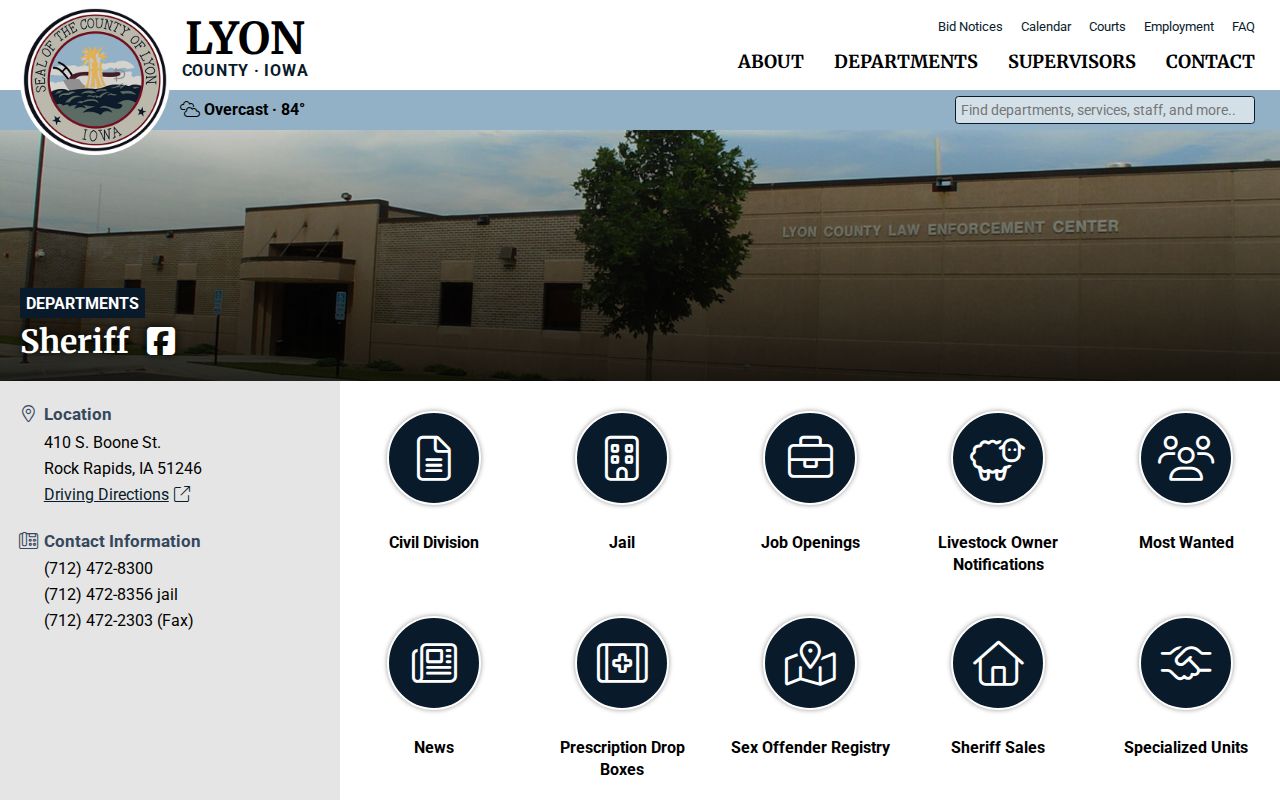
After issuance, the clerk routes the order to the right enforcement agency. The Lyon County Sheriff's Office carries the county's law enforcement load, runs the jail, publishes the warrant list, and serves warrants. Rock Rapids staffs its own police department. George and Inwood document sheriff contract or enforcement arrangements in their official material, and none of the four cities, George, Inwood, Larchwood, or Doon, runs a standalone city warrant portal. Other Iowa peace officers may also act within their authority. The official Lyon County sheriff page lays out the office's county service role and the Law Enforcement Center contact route.
That office route is how Lyon County confirms service. Federal warrants are different, running through federal court and the U.S. Marshals.
Restricted Lyon County Arrest Records
A missing record can be lawful, not an error. The Iowa restricted-document matrix keeps arrest-warrant applications and orders unavailable until execution, the return, or an initial appearance. Search-warrant material can stay closed before service too. Juvenile, sealed, and expunged Lyon County records never show up like ordinary dockets.
Access rule: Absence from a Lyon County public list does not prove there is no arrest warrant; confirm through the clerk and sheriff.
A judicial public-record request can surface an existing Lyon County record. It cannot override a statute, court rule, or sealing order. Include enough case detail for the custodian to find it.
How Warrants Get Served in Lyon County
Once issued, the Lyon County warrant travels from the clerk to law enforcement. Service means an officer executes it by arresting the named person. Iowa Code section 804.21 then requires that the person be brought without unnecessary delay before the nearest or most accessible magistrate. Release terms may turn on the endorsed bond, the law, and the judicial bond schedule.
The local process is: sworn complaint → probable-cause review → arrest warrant → clerk transfer → agency service → initial appearance and bond → return to court → docket and agency update. The Lyon jail FAQ says a magistrate sees an inmate within 24 hours, subject to the stated exceptions. It also says cash is accepted for bond unless a bondsman is used. The FAQ does not create a flat Lyon County warrant-bond amount.
Comparing Lyon County Court Orders
A summons, a new arrest warrant, and a bench-style warrant can all grow from one Lyon County criminal case. They command very different things. Trust the court record, not a guess from a charge name.
| Record | What Starts It | Immediate Effect |
|---|---|---|
| Arrest warrant | Probable-cause finding | Authorizes custody |
| Summons or citation | Authorized notice route | Directs appearance without initial arrest |
| Bench-style FTA warrant | Missed court or noncompliance | Authorizes arrest in an existing matter |
Iowa section 805.5 names the missed-appearance order an arrest warrant for failure to appear. For that specific Lyon County path, see the Lyon County bench warrant process.
If a Lyon County Warrant Exists
Do not drive anywhere on the strength of a web hit alone. A Lyon County warrant needs real details first: case and warrant numbers, the stated charge, any court date, issuing authority, and bond information. Get the docket procedure from the clerk. Then ask the sheriff or jail about current enforcement and custody. A lawyer can call the issuing court, seek a hearing or motion, and arrange a controlled appearance.
- Confirm the order with both the clerk and sheriff.
- Ask an attorney about the safest court response.
- Ask the jail what bond and identification instructions apply if custody is required.
- Follow the court's instructions for appearance, payment, or a case-specific filing.
- Save the disposition, bond receipt, and later status confirmation.
Act carefully: A public record cannot promise safe surrender terms; obtain current directions from the court, sheriff, jail, and counsel.
Confirm Lyon County Warrant Disposition
Service of a warrant is not dismissal, and walking out of jail is not the end of a case. Ask the clerk what the docket shows after an appearance or bond. If a court order resolves the Lyon County warrant, ask when the sheriff's system and the public PDF catch up. Keep every paper. A public snapshot can trail what the court already did. A payment plan only addresses court debt. It may be part of the remedy, yet it does not automatically recall every Lyon County arrest warrant. The court has to enter the order, and the enforcement agency has to receive and record it. Check both offices. That habit cuts the risk of trusting an old list or a thin case screen.